Vulnerability Intelligence Platform
The problem
Most vulnerability tooling starts with the dashboard instead of the data. Teams ingest a public feed, sort by severity, add a few saved filters, and hope analysts can keep up. That works briefly. Once volume rises and data quality varies, the workflow breaks down into manual validation, re-checking views, and constantly second-guessing whether a CVE actually matters.
The root problem is that most systems are built on incomplete or inconsistent enrichment and only expose coarse controls such as final severity, a few exploit flags, or fixed product lists. That is not enough to drive durable automation. A severity threshold floods a queue with noise. A product list misses relevant exposure changes. A saved search tells you what looks important now, but not what the right team needs to see as new vulnerabilities continue to arrive.
The solution
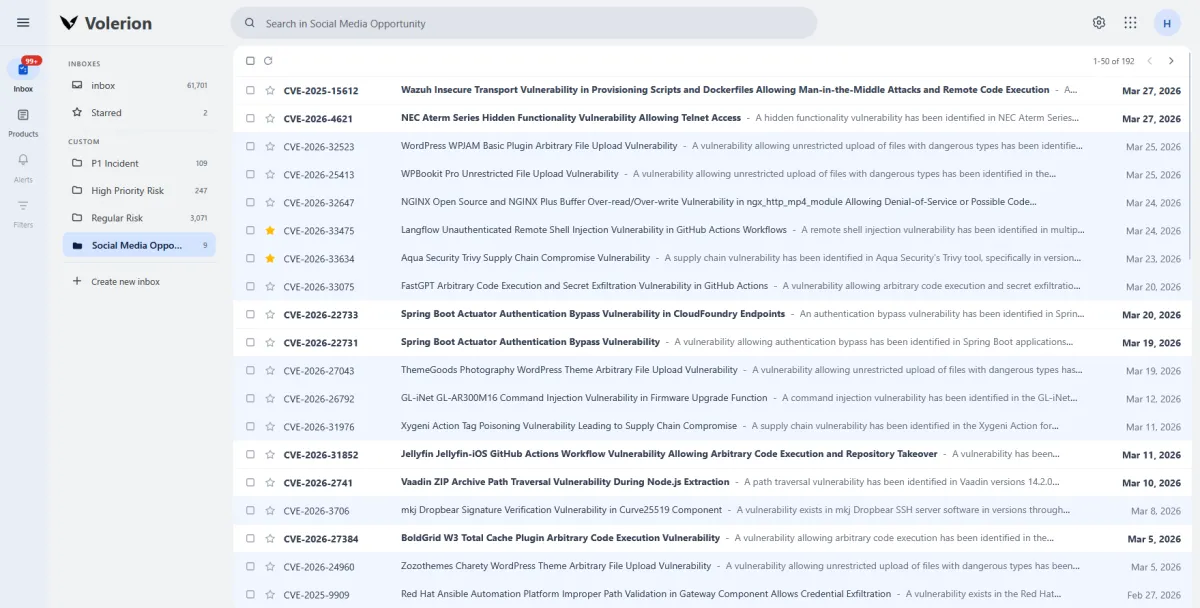
Volerion is a vulnerability intelligence platform built on complete, consistent, and auditable enrichment data. Instead of treating CVEs as a flat list with a score attached, the platform normalizes each record into structured entities that can be filtered, reasoned over, and routed with confidence. The first workflow feature on top of that foundation is CVE Inbox, where new vulnerabilities arrive continuously, policies evaluate each record, and matches land in dedicated inboxes.
That means one inbox can monitor vulnerabilities affecting software your team or customers actually use, another can watch for P1-style incident conditions, and another can collect records for social media or blog posts, outreach, or research. All powered by strong and flexible rules that can evaluate any field in the data, combine multiple conditions with AND/OR logic, and even use custom risk scoring to catch important records that would be missed by severity-based filters.
The platform is designed so teams do not need to sit in the dashboard waiting for something important to appear. Inboxes can push matched vulnerabilities into Slack, ticketing systems, or even AI agent workflows. The dashboard is where logic is configured and reviewed, but the real value is that the workflow continues in the systems where work is already happening.